Blog

  • How to Use ChatGPT for Small Business: 5 Easy Tasks to Start With

    If you run a small business, do not start by trying to automate everything. Start with work that repeats often, is easy to review, and will still be useful even if the first draft is imperfect.

    That is the lowest-risk way to use ChatGPT in a real business. It helps you get quick time savings without handing important decisions to AI too early.

    OpenAI’s small-business-focused materials consistently point toward drafting, customer communication, summarizing, organizing, and templating as practical early use cases.

    Source: OpenAI Academy Small Business Prompt Pack
    https://academy.openai.com/public/clubs/small-business-ipf4m/resources/run-your-small-business-with-chatgpt-2025-11-18

    Source: ChatGPT 101: Introduction to ChatGPT for Small Businesses
    https://academy.openai.com/public/videos/chatgpt-101-introduction-to-chatgpt-for-small-businesses

    Source: ChatGPT 102 for Small Businesses
    https://academy.openai.com/public/videos/chatgpt-102-for-small-businesses

    A simple filter before you use ChatGPT for any business task

    A good first ChatGPT task usually passes three tests:

    1. It happens often.
    2. It is easy for you to review before sending or publishing.
    3. It does not create major risk if the first draft needs correction.

    If a task does not pass those three tests, it is probably not the best place to start.

    1. Customer reply drafts

    This is one of the easiest wins because many small businesses answer similar questions every day.

    • Do you have this in stock?
    • What are your hours?
    • Can I book for next week?
    • Do you offer delivery?

    Instead of typing these from scratch every time, you can build first-draft reply templates and then adjust them case by case.

    Why this works: the final review is still yours, but the blank page disappears.

    2. Business announcements and notices

    Operational updates matter, but they do not need to eat up your writing time.

    • holiday hours,
    • shipping delays,
    • temporary closures,
    • policy changes,
    • schedule changes.

    ChatGPT is useful here because you can turn rough notes into a short, clean customer-facing notice in a minute or two.

    Why this works: the message format is predictable, and the review burden is low.

    3. Repetitive emails and follow-ups

    Most small business owners send the same email patterns over and over again.

    • quote follow-ups,
    • reminder emails,
    • inquiry responses,
    • thank-you emails,
    • re-engagement messages to old leads.

    If you build a small template library, ChatGPT can help you create faster first drafts without lowering your standard.

    Why this works: these messages repeat often and usually need only light editing.

    4. Service descriptions and marketing rewrites

    A lot of owners know what they offer, but struggle to explain it clearly in different formats.

    ChatGPT can help you rewrite the same offer for a website section, Instagram caption, direct message, email, flyer, or short promo line.

    Why this works: the raw facts already exist. You are using AI to improve clarity, not to invent your business.

    5. Meeting notes, task lists, and rough summaries

    ChatGPT is also useful for internal work, especially when scattered notes slow the week down.

    • turning rough notes into action items,
    • summarizing supplier calls,
    • organizing next steps after meetings,
    • converting scattered notes into a checklist.

    Why this works: better summaries reduce small operational friction that quietly wastes time.

    Do not automate these blindly

    • legal or compliance wording,
    • final pricing promises,
    • customer-specific facts,
    • fully autonomous support replies.

    Better rule: use ChatGPT for first drafts and organization first, not for unsupervised final decisions.

    A practical 1-week way to test this

    1. Pick one repetitive task.
    2. Collect 5 real examples.
    3. Turn them into 3–5 reusable templates.
    4. Review every output before using it.
    5. Measure whether you saved time after one week.

    You do not need an “AI strategy” to get started. You need one useful, low-risk win.

    For most small businesses, that first win is getting back small pieces of time every day.

    Sources

    • OpenAI Academy Small Business Prompt Pack: https://academy.openai.com/public/clubs/small-business-ipf4m/resources/run-your-small-business-with-chatgpt-2025-11-18
    • ChatGPT 101: Introduction to ChatGPT for Small Businesses: https://academy.openai.com/public/videos/chatgpt-101-introduction-to-chatgpt-for-small-businesses
    • ChatGPT 102 for Small Businesses: https://academy.openai.com/public/videos/chatgpt-102-for-small-businesses

  • Where Small Businesses Should Use ChatGPT First: 5 Low-Risk Tasks to Automate

    Most small business owners do not need “AI automation” first. They need a safer way to save time this week without creating new mistakes. The best place to start is work that repeats often and is easy to review before it reaches a customer.

    If you use that filter, ChatGPT becomes much easier to apply in the real world. You do not have to guess where AI fits. You start with low-risk tasks where the time savings are obvious and the downside is limited.

    OpenAI’s small-business-focused materials consistently point to drafting, customer communication, summarizing, organizing, and templating as practical early use cases.

    Source: OpenAI Academy Small Business Prompt Pack
    https://academy.openai.com/public/clubs/small-business-ipf4m/resources/run-your-small-business-with-chatgpt-2025-11-18

    Source: ChatGPT 101: Introduction to ChatGPT for Small Businesses
    https://academy.openai.com/public/videos/chatgpt-101-introduction-to-chatgpt-for-small-businesses

    Source: ChatGPT 102 for Small Businesses
    https://academy.openai.com/public/videos/chatgpt-102-for-small-businesses

    A quick filter: what makes a good first ChatGPT task?

    1. It happens often.
    2. You can review it quickly before it goes out.
    3. The first draft still helps even if it needs correction.

    If a task does not pass those three tests, it is probably not the best place to start.

    1. Customer reply drafts

    This covers the repetitive questions that show up every week: stock checks, hours, availability, delivery questions, and booking inquiries.

    Why it is a good first use case: the format repeats, the owner can review the reply in seconds, and the blank page disappears.

    2. Business notices and operational updates

    This includes short updates like holiday hours, temporary closures, schedule changes, shipping delays, or policy notices.

    Why it is a good first use case: the information is already known, the message is short, and the review burden is low.

    3. Repetitive emails and follow-ups

    This covers quote follow-ups, reminders, inquiry responses, thank-you emails, and re-engagement messages to old leads.

    Why it is a good first use case: these messages repeat often, and ChatGPT can help turn them into reusable templates instead of one-off writing sessions.

    4. Service descriptions and marketing rewrites

    This is useful when you know what you offer but struggle to explain it clearly across your website, social posts, DMs, emails, or flyers.

    Why it is a good first use case: the facts already exist. ChatGPT is helping you rewrite and clarify, not invent the business itself.

    5. Notes, task lists, and rough summaries

    This includes turning rough meeting notes into action items, summarizing supplier calls, and organizing next steps into a checklist.

    Why it is a good first use case: better summaries remove small daily friction and make execution cleaner without much downside.

    Do not automate these blindly

    • legal or compliance wording,
    • final pricing promises,
    • customer-specific factual claims,
    • fully autonomous support replies.

    Better rule: use ChatGPT for first drafts and organization first, not for unsupervised final decisions.

    A simple way to test this in one week

    1. Pick one repetitive task.
    2. Collect 5 real examples.
    3. Turn them into reusable templates.
    4. Review every output before using it.
    5. Check whether the task took less time after one week.

    You do not need a full AI strategy to start. You need one low-risk win that saves time in real work.

    Sources

    • OpenAI Academy Small Business Prompt Pack: https://academy.openai.com/public/clubs/small-business-ipf4m/resources/run-your-small-business-with-chatgpt-2025-11-18
    • ChatGPT 101: Introduction to ChatGPT for Small Businesses: https://academy.openai.com/public/videos/chatgpt-101-introduction-to-chatgpt-for-small-businesses
    • ChatGPT 102 for Small Businesses: https://academy.openai.com/public/videos/chatgpt-102-for-small-businesses
  • Why Bridge Open Issuance Matters More Than “Launch Your Own Stablecoin”

    Bridge Open Issuance matters because it lowers the friction of launching stablecoin products. That does not mean every startup should launch one. It means the infrastructure layer is getting easier to assemble, which changes what founders can seriously consider building.

    For startup readers, that is the real takeaway. The interesting part is not the marketing line about “launch your own stablecoin.” The interesting part is that pieces which used to feel institution-only are becoming more productizable.

    Why this matters more than the headline

    When infrastructure gets easier to use, the opportunity is usually not in copying the headline product. The opportunity is in the second-order applications that become newly practical.

    That is why Bridge Open Issuance matters. It is not just a “stablecoin launch” story. It is a signal that the tooling around internet-native money is becoming easier to package into startup products.

    What changed

    The product promise is simple: make stablecoin issuance easier to launch and operate. For founders, the strategic implication is that the barrier between payment infrastructure and product design keeps dropping.

    What startup founders should actually pay attention to

    • whether stablecoin rails become embedded inside vertical software rather than sold as standalone fintech features
    • whether treasury, payouts, and cross-border flows become default product primitives
    • whether compliance and orchestration layers become a new startup wedge

    What this does not mean

    This does not mean stablecoin products suddenly become easy businesses. Distribution, trust, compliance, and user demand still matter. But it does mean that more teams can now experiment with these rails without starting from scratch.

    Founder takeaway

    If you are a founder, the useful question is not “should I launch a stablecoin?” The better question is: what product becomes more viable if stablecoin issuance and movement become easier to integrate?

    That is where the real startup opportunity is likely to appear.

  • Why Stripe’s Machine Payments Protocol Matters More Than It First Appears

    What startup founders should watch

    • whether agents become credible intermediaries for procurement and software operations
    • whether approval, trust, identity, and payment rules become product opportunities
    • whether new startup wedges appear around orchestration rather than raw model capability

    What not to overclaim

    This does not prove agentic commerce is already here. It does not prove customers want software buying software at scale. And it does not mean every startup should now pivot to “AI agents for payments.”

    But it does suggest that serious infrastructure companies see enough possibility here to start shaping the rails early.

    Founder takeaway

    If you are building for the future of software operations, the useful question is not “is this trend fully proven?” The better question is: what new product becomes possible if machine-mediated payments become trustworthy enough to use?

    That is the startup lens worth keeping on this announcement.

    Stripe’s Machine Payments Protocol matters because it hints at what payment infrastructure might look like in an agent-driven economy. The important question is not whether autonomous software buyers are already mainstream. The important question is what infrastructure companies are building now in case they become real.

    That is why this announcement matters to startup readers. Stripe is not just adding another AI-adjacent feature. It may be testing a payments layer for a future where software can discover, authorize, and complete transactions with less human intervention.

    Why founders should care now

    Founders do not need to believe in a fully autonomous commerce future to care about this. They only need to notice that major infrastructure players are beginning to prepare for it.

    That matters because infrastructure usually shows up before startup categories become obvious. The teams that notice the pattern early often build the most useful application layers on top of it.

    What the deeper signal is

    The deeper signal is not “agents can buy things now.” The deeper signal is that Stripe appears to be exploring what trusted payment coordination might require if agentic commerce becomes normal enough to support new product behavior.

    What startup founders should watch

    • whether agents become credible intermediaries for procurement and software operations
    • whether approval, trust, identity, and payment rules become product opportunities
    • whether new startup wedges appear around orchestration rather than raw model capability

    What not to overclaim

    This does not prove agentic commerce is already here. It does not prove customers want software buying software at scale. And it does not mean every startup should now pivot to “AI agents for payments.”

    But it does suggest that serious infrastructure companies see enough possibility here to start shaping the rails early.

    Founder takeaway

    If you are building for the future of software operations, the useful question is not “is this trend fully proven?” The better question is: what new product becomes possible if machine-mediated payments become trustworthy enough to use?

    That is the startup lens worth keeping on this announcement.

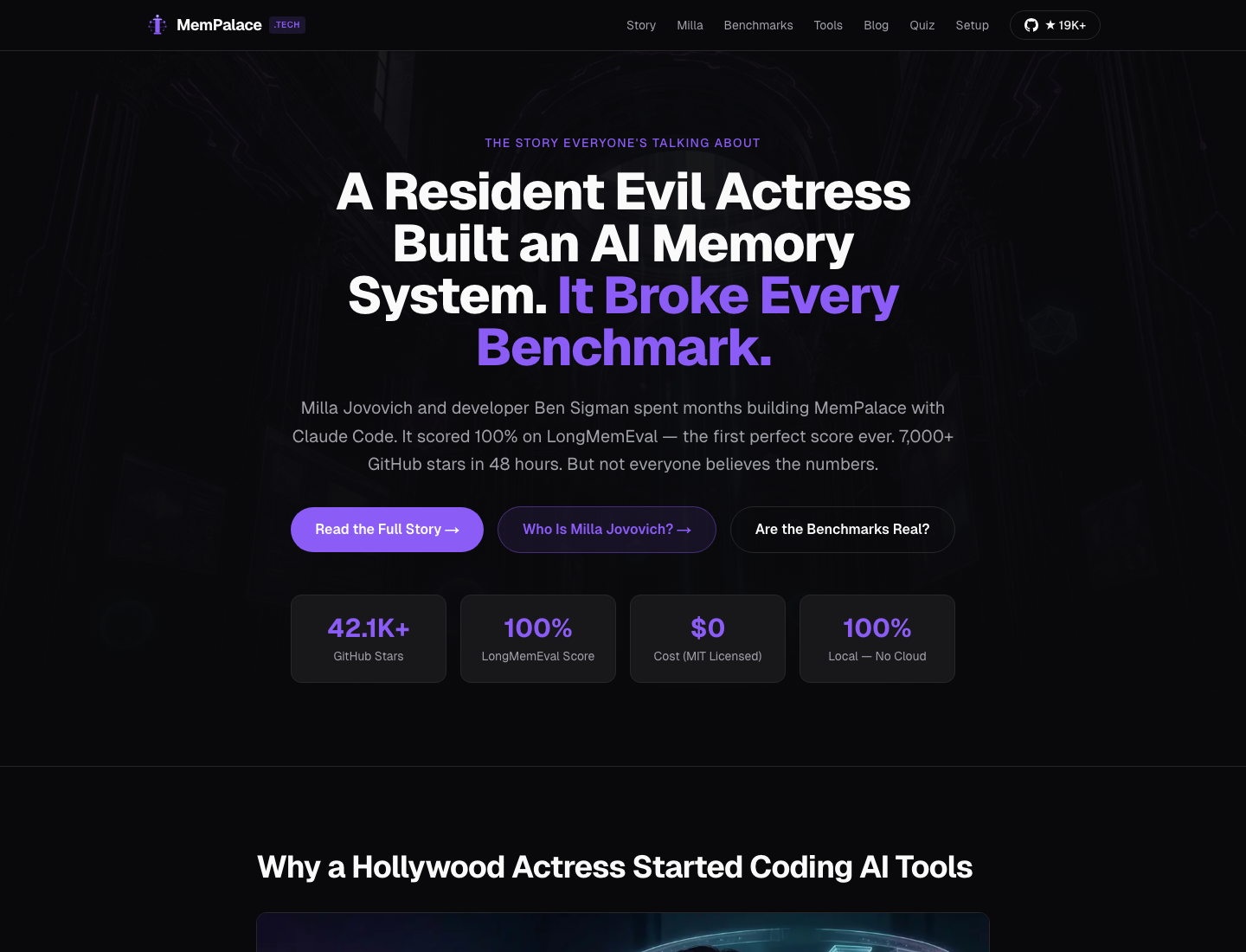
  • Is MemPalace Real Innovation or Just Aggressive Marketing?

    A celebrity-backed open-source project can get attention on its own. A celebrity-backed AI memory project with a “100%” benchmark claim gets something more volatile: curiosity, hype, and immediate distrust.

    That is what happened with MemPalace.

    The project arrived with an irresistible launch story. Milla Jovovich, best known to most people as the face of Resident Evil, was suddenly attached to an open-source AI memory system. The repository took off. The site pushed phrases like “highest-scoring,” “free,” and “local-first.” And the pitch landed in a market already primed for it, because AI power users have been living with the same frustration for months: sessions end, context disappears, and reasoning has to be rebuilt from scratch.

    That is why MemPalace matters. Not because a celebrity touched an open-source repository, but because it puts a serious question back on the table: what should an AI memory system actually remember?

    The Real Problem MemPalace Is Pointing At

    Most people who use AI heavily do not just lose answers. They lose the path that led to the answer.

    They lose the earlier debate, the discarded alternative, the half-finished idea, the reason a decision changed, the context that made a tradeoff make sense in the first place. That is the kind of loss that makes many AI systems feel smart in the moment and forgetful across time.

    Most memory products try to solve that by compressing conversations into extracted facts, summaries, traits, or user preferences. In many situations, that works. But it also creates a deeper risk: once the system decides what matters, the reasoning context is already gone.

    MemPalace takes the opposite philosophical position. Its core idea is simple: do not let the model decide what is worth remembering too early. Store the original material, then make it searchable later.

    That is not just a feature choice. It is a theory of memory.

    What MemPalace Actually Is

    At a practical level, MemPalace presents itself as a local-first AI memory system built around verbatim storage and later retrieval. Public materials describe a structure made of wings, rooms, halls, closets, and drawers—a memory-palace metaphor used to organize the system’s retained context.

    Under that framing, the most important concept is not the metaphor itself. It is the insistence that the original material should remain available.

    That matters because many memory systems are strongest when the goal is extracting stable facts. MemPalace is more ambitious in a different way. It is trying to preserve the context that sits behind those facts.

    That makes the project genuinely interesting.

    Why the Idea Is Stronger Than the Launch Story

    The celebrity angle got the clicks, but the design philosophy is what gives the project weight.

    The real challenge MemPalace poses to the rest of the market is this: if AI systems are allowed to decide what to forget, are they discarding exactly the material advanced users care about most?

    That question hits a real nerve. Many people using AI for research, writing, strategy, product work, or technical reasoning do not just want a summary. They want recoverable context. They want to know what was said, why it mattered, what alternatives were rejected, and where the uncertainty lived.

    In that sense, MemPalace is not just shipping a tool. It is arguing for a different standard.

    Where the Skepticism Becomes Necessary

    The project becomes harder to trust once you move from the philosophy to the launch marketing.

    This is the part that should not be blurred.

    The MemPalace README now contains a visible correction note that acknowledges multiple launch-era overstatements or misleading framings. That already tells you something important: the criticism was not merely external noise. Some of it was serious enough that the project had to revise its own presentation.

    • the AAAK token example was inaccurate,
    • the “30x lossless compression” framing was overstated,
    • the “+34% palace boost” framing overstated what was effectively metadata filtering,
    • contradiction detection was described more strongly than the implementation justified,
    • and the public benchmark story around the 100% reranked result was not fully transparent.

    This is why MemPalace cannot be read honestly as either pure breakthrough or pure fraud. The more accurate reading is harder to summarize: there is a real idea here, but the launch framing pushed harder than the evidence justified.

    The Benchmark Problem, Broken Into Three Parts

    1. The headline problem

    “100% on LongMemEval” is a powerful sentence. But it flattens too much. Raw mode, hybrid mode, reranking, API dependency, and evaluation setup can all disappear behind a single number.

    That does not make the number fake by definition. It does make it incomplete in a way that matters.

    2. The methodology problem

    A second layer of criticism focuses on how the result was achieved or communicated. External critiques have pointed to question-specific tuning, retrieval settings, and evaluation framing that may make the headline result look broader or cleaner than it really is.

    This is not just academic nitpicking. It goes directly to whether readers should treat the launch claim as a robust result or as a best-case marketing number.

    3. The attribution problem

    Even when retrieval performance is genuinely impressive, it does not follow that every architectural layer deserves equal credit. Raw retrieval quality, metadata filtering, optional compression, and the palace structure itself should not be blended into one magical story about why the system works.

    In other words: the benchmark may still reflect something real, but the story told about that benchmark has to be read with caution.

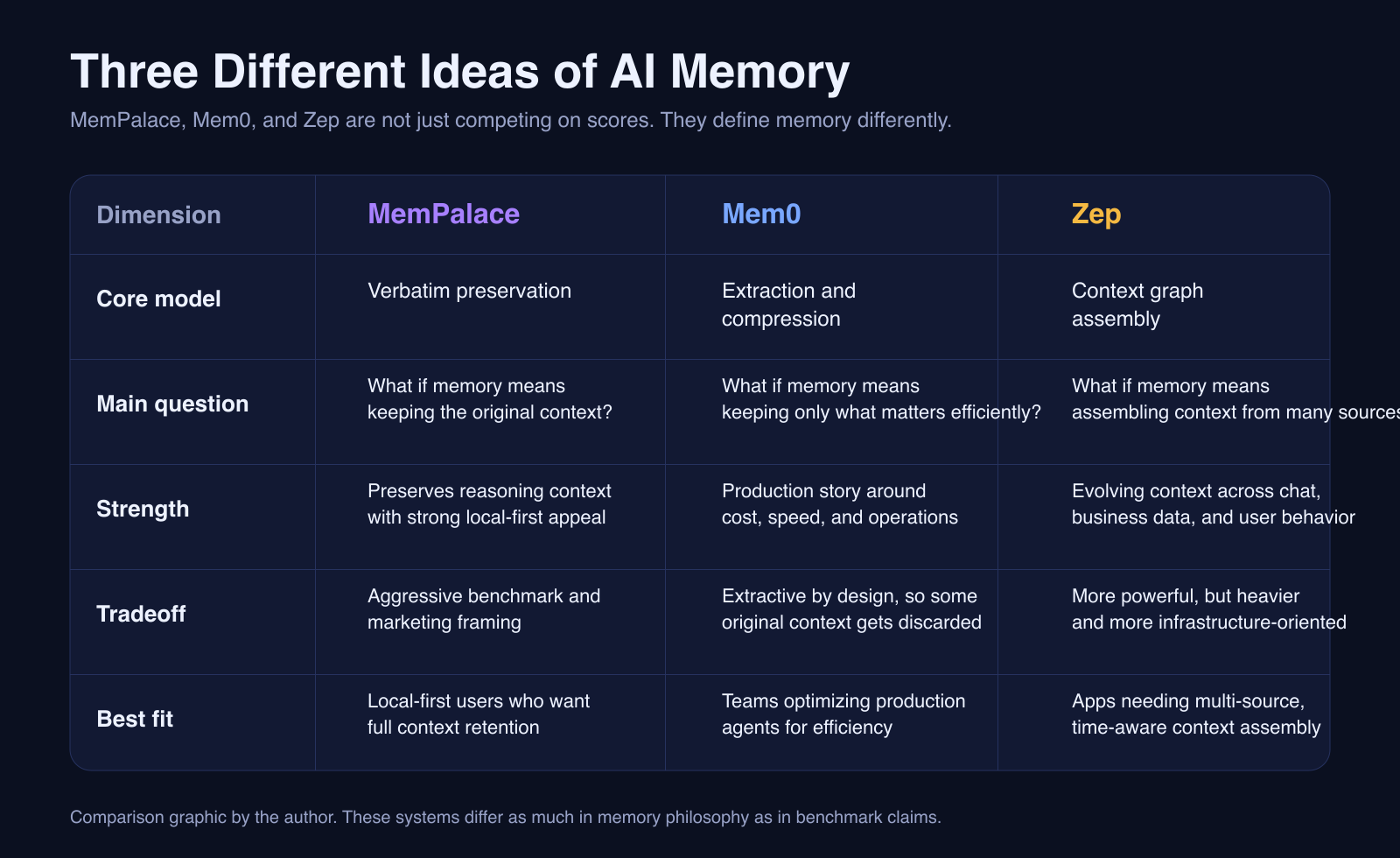
    MemPalace, Mem0, and Zep Are Solving Different Problems

    The easiest way to make sense of MemPalace is to stop treating it as a simple benchmark rival and compare it to other systems by memory philosophy.

    MemPalace is fundamentally a verbatim-preservation system. It is local-first, open-source, and biased toward keeping the original context available.

    Mem0, by contrast, feels much closer to an extraction-and-compression memory layer for production AI apps. Its messaging leans toward cost savings, latency improvements, observability, and enterprise readiness. It is trying to preserve what matters efficiently, not preserve everything.

    Zep pushes in yet another direction. It frames itself as context engineering: temporal knowledge graphs, evolving facts, user behavior, business data, and assembled context for real-time agents. That makes it more infrastructure-heavy, but also potentially more powerful in larger application environments.

    • MemPalace asks: what if memory means preserving original context?
    • Mem0 asks: what if memory means extracting what matters efficiently?
    • Zep asks: what if memory means assembling the right context from multiple changing sources?

    This is not just a ranking problem. It is a definition problem.

    My View

    MemPalace does not strike me as a fake project. It strikes me as a real and genuinely interesting local AI memory system with a strong point of view.

    But it also strikes me as a project that damaged its own credibility by trying to win too quickly with launch messaging that was more aggressive than it should have been.

    That matters because good ideas often become less legible when marketing gets ahead of the evidence. The tragedy is not that MemPalace has no substance. The tragedy is that it may have had enough substance to be interesting without overplaying the benchmark story.

    So my conclusion is simple.

    MemPalace is not compelling because a celebrity helped launch it. It is compelling because it reopens a serious question about AI memory: should memory optimize for compressed summaries, or for preserving the original context people may actually need later?

    That is the part worth taking seriously.

    The benchmark headline is the part worth doubting.

    And the most honest way to read the project is to hold both of those truths at once.

  • What Makes an AI Agent Architecture Reliable? Weak vs Strong Harness Design

    By now, the pattern should be clear.

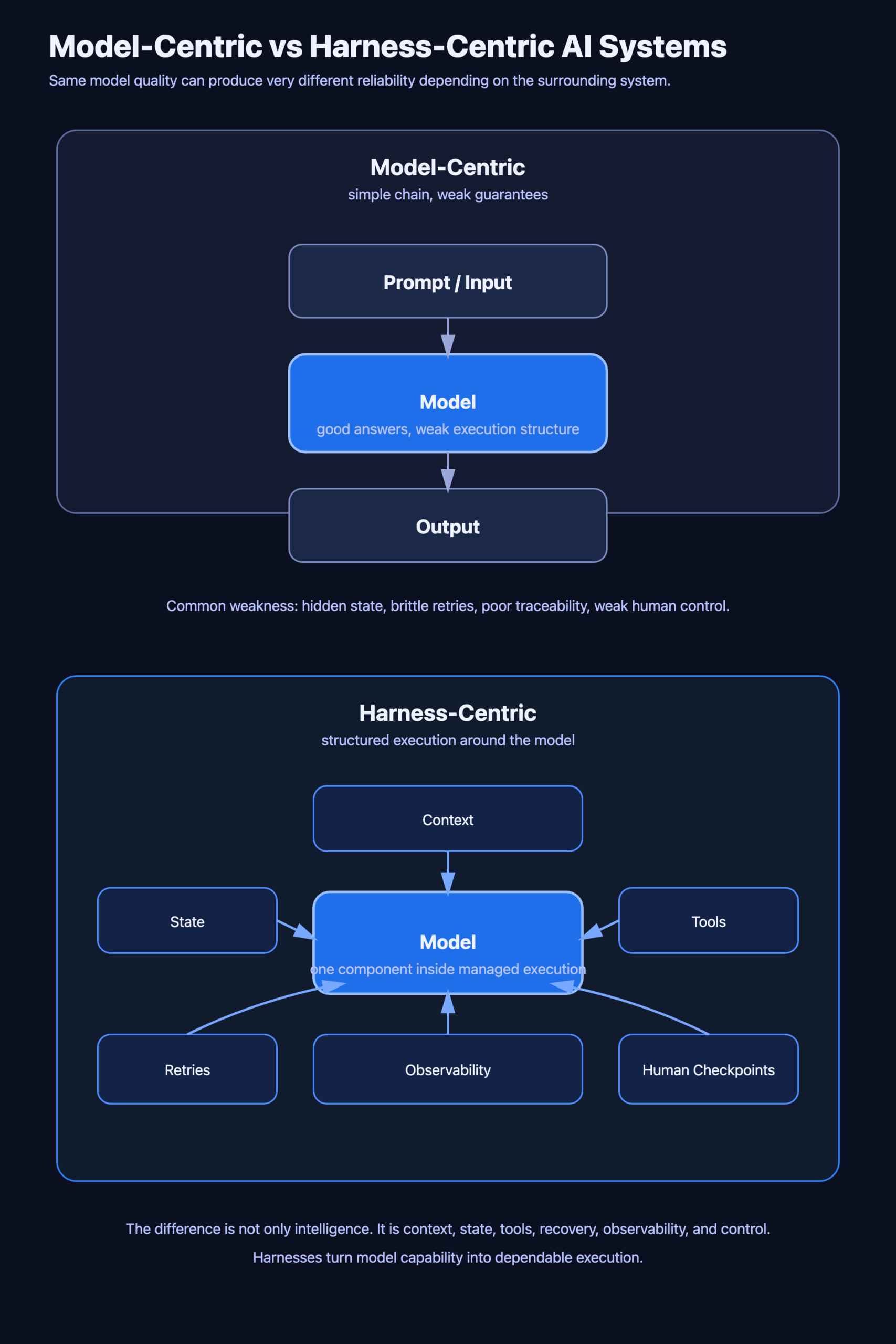
    Better models matter. But once AI systems are expected to do real work, model quality stops being the whole story. What matters just as much is the harness around the model: the structure that gives the system context, state, tools, recovery, observability, and human control. In practice, this is what determines whether an AI agent architecture is reliable enough for real-world use.

    That is where the difference between weak and strong systems starts to appear.

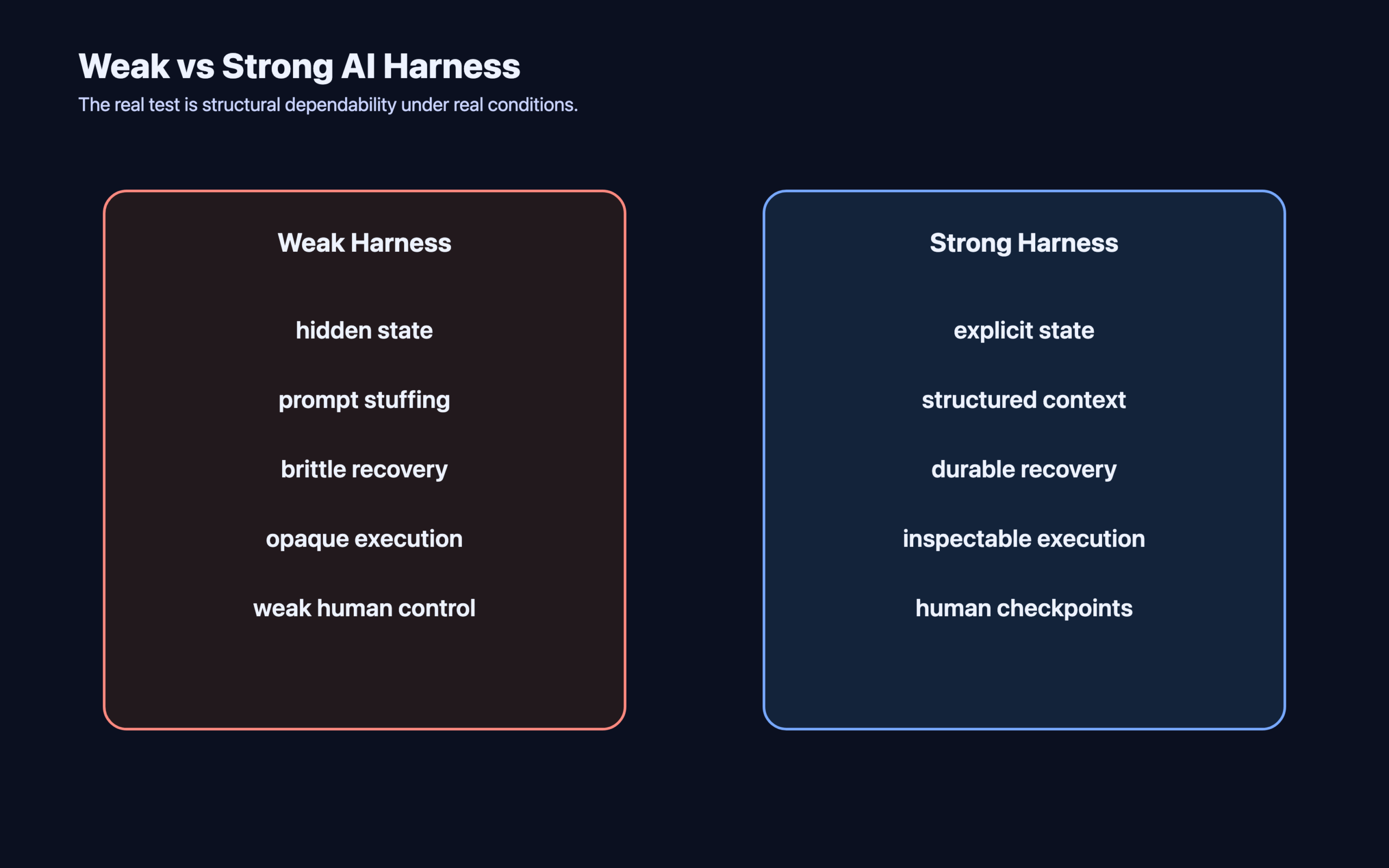
    What weak harnesses tend to look like

    A weak harness can still look impressive at first.

    It may produce fluent answers. It may complete a short task. It may even demo well under controlled conditions. But once the workflow becomes messy, the weaknesses start to surface.

    Weak harnesses usually share some combination of the same traits:

    • hidden or poorly managed state
    • context handled as prompt stuffing rather than structured retrieval or memory
    • tool execution that is improvised rather than governed
    • little durability when a step fails or the workflow is interrupted
    • poor observability when something goes wrong
    • weak or missing human checkpoints

    The common pattern is not that the model is necessarily weak. The common pattern is that the surrounding system cannot hold together once reality becomes inconvenient.

    What strong harnesses tend to look like

    A strong harness usually does the opposite.

    It makes workflow state explicit. It treats context as a managed system layer rather than a pile of extra text. It wraps tool use inside clearer boundaries. It can retry, resume, checkpoint, and recover. It emits traces that let humans inspect what happened. And it leaves room for approval, intervention, and correction when the workflow matters.

    This is what reliable AI agent architecture looks like in practice: explicit state, structured context, tool orchestration, workflow durability, observability, and meaningful human checkpoints.

    This does not make the system perfect. It makes it dependable.

    That distinction matters. A strong harness is not one that never fails. It is one that fails in ways the system can survive, inspect, and improve.

    Why weak harnesses still look good in demos

    One reason weak harnesses are easy to overestimate is that demos compress time and complexity.

    A short demo hides interrupted workflows, partial failures, stale state, retry logic, messy context changes, and human handoffs. A strong model can cover a lot of structural weakness for a few minutes.

    That is why isolated outputs are often misleading. The more serious question is what happens when the task runs longer, tools misbehave, or the surrounding environment changes.

    A weak harness often looks strongest right before it is stressed.

    Public systems are revealing stronger patterns

    Public harness-oriented systems are useful because they show what stronger patterns actually look like in practice.

    LangGraph makes explicit state and workflow structure central rather than hidden.

    Source URL: https://github.com/langchain-ai/langgraph

    Restate’s AI examples emphasize durable execution, retries, and resilience.

    Source URL: https://github.com/restatedev/ai-examples

    Dapr Agents treats workflows, messaging, state, telemetry, and execution boundaries as part of the architecture itself.

    Source URL: https://github.com/dapr/dapr-agents

    The OpenTelemetry MCP server shows observability moving closer to the agent layer, making traces more accessible to the system and its operators.

    Source URL: https://github.com/traceloop/opentelemetry-mcp-server

    The paper Building AI Coding Agents for the Terminal: Scaffolding, Harness, Context Engineering, and Lessons Learned is also useful because it treats scaffolding, context engineering, and task structure as central engineering problems rather than secondary details.

    Source URL: https://arxiv.org/html/2603.05344v1

    And the awesome-harness-engineering repository is helpful as a category map because it makes visible how many of these same layers keep reappearing across the field.

    Source URL: https://github.com/walkinglabs/awesome-harness-engineering

    The point is not that these projects are identical. The point is that they keep converging on the same needs.

    A practical way to judge a harness

    If you want a more useful question than “How good is the model?”, try asking this instead:

    • Can the system represent and update state explicitly?
    • Can it supply context in a structured, task-relevant way?
    • Can it govern tool use rather than improvising it?
    • Can it recover when a step fails?
    • Can humans inspect what happened through logs, traces, or checkpoints?
    • Can the workflow continue without becoming opaque or brittle?

    This is not a scorecard. It is a structural lens.

    A harness is strong when the system can keep working under pressure without becoming invisible, fragile, or unrecoverable. That is also what makes reliable AI systems possible outside short-lived demos.

    The series-level lesson

    This is the broader lesson of the whole series.

    Part 1 argued that harness engineering is becoming more decisive. Part 2 showed that context structure matters. Part 3 showed that durability changes the engineering problem. Part 4 showed that public systems keep converging on the same architecture layers.

    Part 5 turns all of that into a judgment criterion: the real test of an AI system is not whether it can impress in one moment, but whether its surrounding structure can preserve capability when conditions become real.

    Bottom line

    The difference between a weak AI harness and a strong one is not whether the model can impress you once. It is whether the surrounding system can preserve capability under real conditions.

    That means state, context, tool governance, durability, observability, and human control are not side topics. They are the practical criteria that determine whether an AI system is only persuasive or actually dependable.

    That is the larger lesson of this whole series. As models improve, more of the real engineering advantage moves into the harness.

    Sources

  • The Architecture Patterns That Keep Reappearing in AI Harness Systems

    One of the easiest ways to misunderstand the current agent landscape is to focus too much on product names.

    One system uses graphs. Another emphasizes durable workflows. Another focuses on telemetry. Another packages itself around MCP servers or infrastructure APIs. On the surface, these systems can look very different. But if you compare them at the architecture level, something more important appears.

    The same patterns keep coming back.

    That is the deeper signal. The field is not only producing more agent frameworks. It is converging on a shared set of harness layers.

    Why pattern-level comparison matters

    Tool names change quickly. Architecture lessons usually last longer.

    If you compare systems only by branding, language, or surface features, you miss the more durable story. The useful question is not which project has the best demo page. The useful question is which design choices keep reappearing when builders try to make agents usable in the real world.

    That is why pattern-level comparison matters. It helps separate what is fashionable from what is becoming necessary.

    The repository awesome-harness-engineering is useful here because it already organizes the field around recurring categories rather than around a single winning tool.

    Source URL: https://github.com/walkinglabs/awesome-harness-engineering

    That kind of category map is a signal in itself. It suggests that builders are spending time on shared system problems, not just isolated implementations.

    Pattern 1: explicit state

    One of the clearest recurring patterns is explicit state.

    A weak harness hides workflow state inside model messages, scattered prompts, or untracked local assumptions. A stronger harness makes state visible and structured.

    LangGraph is an obvious example because it treats agent execution as a stateful graph rather than a vague sequence of calls.

    Source URL: https://github.com/langchain-ai/langgraph

    The point is not that every system must literally be graph-shaped. The point is that real workflows need state that can be inspected, updated, and reasoned about deliberately.

    Pattern 2: structured context

    The second recurring pattern is structured context.

    Useful systems keep moving away from the idea that context means pasting more text into a prompt. Instead, they treat context as a managed layer: memory, retrieval, indexing, structure, and task-relevant focus.

    This is one reason the harness conversation keeps intersecting with codebase context, memory systems, and retrieval design. The architecture is telling us that context is not just input volume. It is a system responsibility.

    Again, the category structure in awesome-harness-engineering is useful evidence because it places context and memory alongside guardrails, evals, observability, and runtimes rather than treating them as side concerns.

    Source URL: https://github.com/walkinglabs/awesome-harness-engineering

    Pattern 3: tool boundaries and execution interfaces

    Another repeated pattern is the way serious systems mediate tool use.

    In weak systems, tool execution can feel like an improvised extension of prompting. In stronger systems, tools are wrapped, constrained, typed, mediated, and connected to broader workflow logic.

    Dapr Agents is useful here because it frames agent execution in terms of workflows, messaging, state, telemetry, and infrastructure concerns rather than as a single free-floating model call.

    Source URL: https://github.com/dapr/dapr-agents

    That matters because it shows tool use becoming part of a governed execution interface, not just a trick for making the model look more capable.

    Pattern 4: durability and recovery

    Once workflows become longer-running, another pattern appears: durability.

    Systems that aim at real work keep adding retries, persistence, resumability, and recovery-aware execution. This is not decorative engineering. It is the difference between something that works once and something that can survive production conditions.

    Restate’s AI examples are useful evidence because they make durability, retries, and resilience part of the public story rather than hiding them in infrastructure layers nobody talks about.

    Source URL: https://github.com/restatedev/ai-examples

    This pattern also reinforces a larger point from Part 3 of this series: workflow time changes the architecture.

    Pattern 5: observability

    A fifth recurring pattern is observability.

    As agents become more capable and workflows become more layered, it becomes harder to trust opaque execution. Builders need traces, telemetry, inspection points, and a way to connect bad outcomes back to specific steps.

    The OpenTelemetry MCP server is a useful sign of this direction because it suggests observability moving closer to the agent layer itself.

    Source URL: https://github.com/traceloop/opentelemetry-mcp-server

    LangSmith’s MCP server points in a similar direction, connecting tooling and inspection more directly into the agent ecosystem.

    Source URL: https://github.com/langchain-ai/langsmith-mcp-server

    This matters because observability is not just a monitoring concern. It is part of how a harness learns, debugs, and improves.

    Pattern 6: human checkpoints

    One more recurring pattern is human-aware control.

    Serious harnesses do not assume perfect autonomy. They assume that humans may need to approve, redirect, inspect, or override system behavior.

    This pattern may be less flashy than model demos, but it shows up repeatedly because it reflects real operational conditions. The more consequential the workflow becomes, the more important it is to keep meaningful checkpoints in the loop.

    That is also why many harness discussions naturally connect approvals, guardrails, auditability, and intervention. These are not signs that the system is weak. They are signs that the system is being designed for reality.

    The deeper takeaway

    What matters here is not that every public system looks the same. They do not.

    What matters is that the same architectural needs keep resurfacing from multiple directions. Different teams, tools, and ecosystems keep rediscovering the same requirements once they move beyond toy workflows.

    That is why this convergence matters. It suggests the field is not just experimenting randomly. It is slowly identifying the layers that serious agent systems require.

    Bottom line

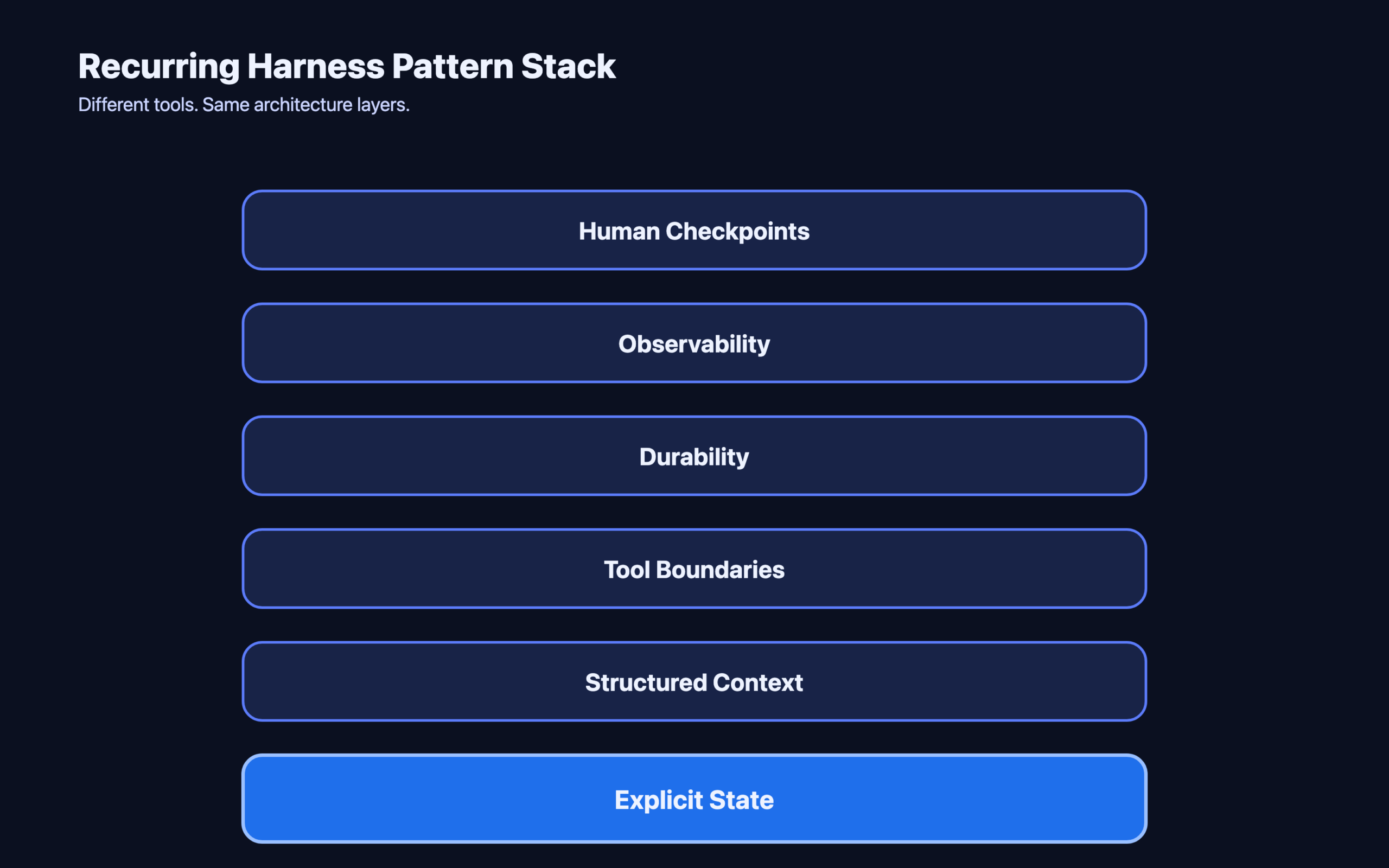
    Public harness-oriented systems may look different on the surface, but they keep converging on the same architecture layers.

    Those layers include:

    • explicit state
    • structured context
    • tool boundaries
    • durability and recovery
    • observability
    • human checkpoints

    This is the real signal in the current landscape. The field is not just experimenting with many random agent ideas. It is gradually discovering the same system requirements from multiple directions.

    In the final part of this series, I will turn that convergence into a sharper question: if these layers keep reappearing, what actually separates a weak harness from a strong one?

    Sources

  • Why Long-Running AI Agents Need Durability, State, and Recovery

    A lot of agent demos are misleading in one specific way: they hide time.

    A model receives a prompt, calls a tool or two, produces an answer, and the system looks capable. But real agent work rarely happens in one clean burst. It unfolds over time. The agent has to survive partial failures, retries, interruptions, changing context, and multi-step execution. Once that happens, the problem stops looking like prompt engineering and starts looking like workflow engineering.

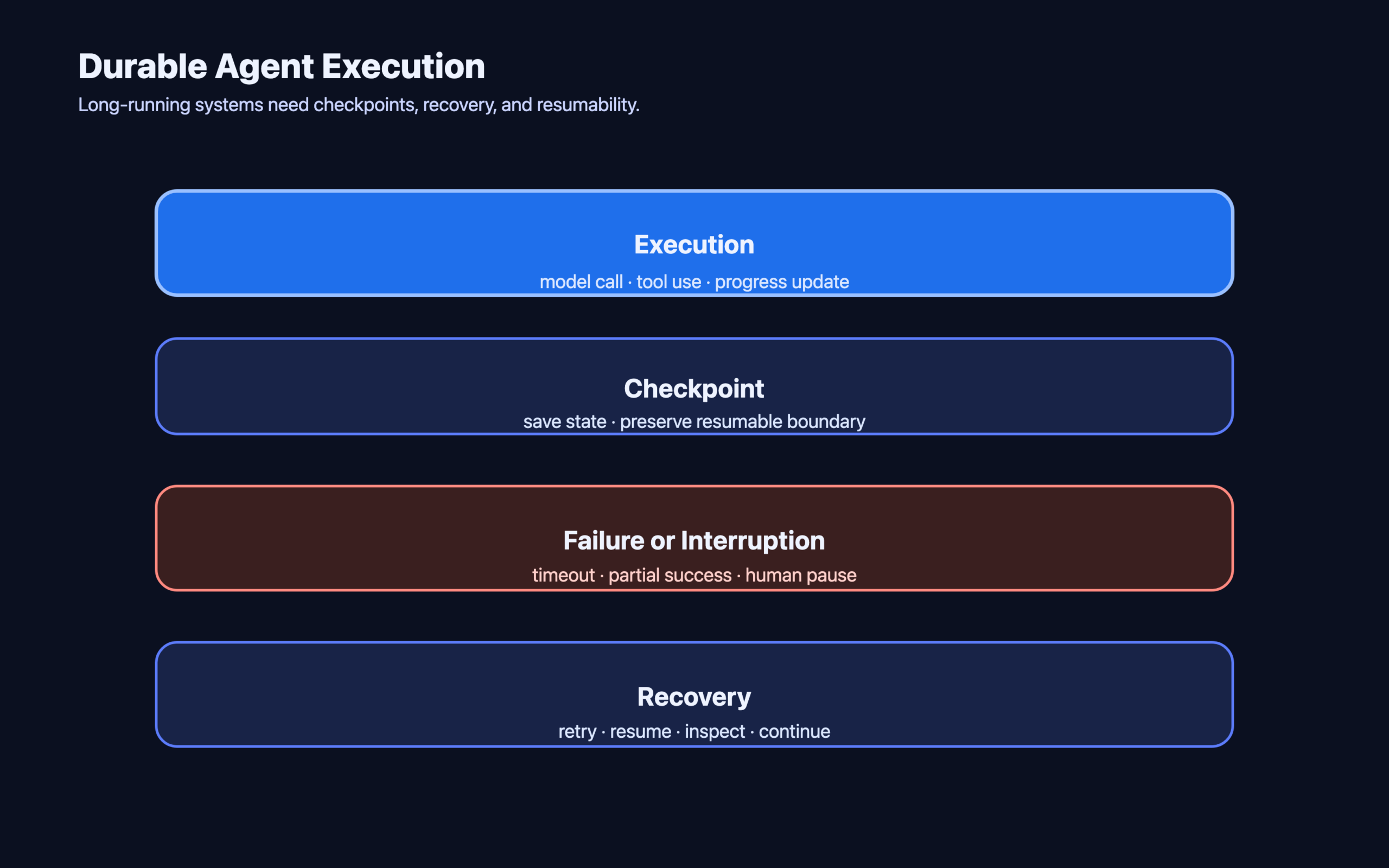
    That is the real shift: as agents move from one-shot responses to ongoing work, durability becomes part of the core architecture.

    Why long-running work changes the engineering problem

    The moment work becomes long-running, a different class of failure appears.

    A tool call times out. A shell command only partly succeeds. An API call fails after earlier steps already changed state. A user interrupts the task and comes back later. The system needs to resume from a meaningful checkpoint instead of starting over blindly.

    This is the gap between a system that can produce a good answer once and a system that can make progress reliably.

    The paper Building AI Coding Agents for the Terminal: Scaffolding, Harness, Context Engineering, and Lessons Learned is useful here because it does not describe execution as a single model response. It describes shell integration, task state, tool behavior, and explicit completion signals as part of the system itself.

    Source URL: https://arxiv.org/html/2603.05344v1

    That framing matters because long-running systems fail in ways that one-shot demos do not show. The problem is not just whether the model can reason. The problem is whether the surrounding system can preserve progress when the world is messy.

    One-shot generation is not durable execution

    A one-shot workflow can look stable simply because it has not been stressed.

    If a model reads input, produces output, and exits, many important system questions remain hidden. What happens if the third step fails after the first two succeeded? What happens if the same task is retried? What happens if a human pauses the process and returns later? What happens if downstream state has changed while the task was waiting?

    These are not edge cases. They are normal production conditions.

    This is why durable execution matters. Durability means the system can preserve state, resume from checkpoints, retry safely, and recover without losing the integrity of the workflow.

    A system that works only when nothing goes wrong is not durable. It is lucky.

    What durability actually means

    In practice, durability usually includes some combination of:

    • persistent workflow state
    • explicit checkpoints
    • retries and backoff
    • resumability after interruption
    • safe replay or idempotent recovery paths
    • traces and logs for inspection
    • human checkpoints for correction or approval

    These are not implementation details that sit outside the AI system. They shape whether an agent can do real work over time.

    Durability is what allows a system to move from “the model produced something plausible” to “the workflow completed safely and can be inspected, resumed, or retried when needed.”

    Public systems are already treating this as infrastructure

    The open-source landscape is useful here because it shows what builders are actually investing in.

    Restate’s AI examples emphasize durable execution, resilience, retries, persistence, and long-running workflow behavior.

    Source URL: https://github.com/restatedev/ai-examples

    That matters because it shows durability being treated as a first-class systems concern rather than as cleanup after the fact.

    Dapr Agents reflects a similar mindset. The project brings together workflow orchestration, messaging, state, and telemetry around agent execution.

    Source URL: https://github.com/dapr/dapr-agents

    LangGraph is another clear signal. Its model is explicitly stateful and graph-oriented, which makes long-running workflow structure visible rather than implicit.

    Source URL: https://github.com/langchain-ai/langgraph

    Even outside AI-branded tooling, durable workflow engines such as Conductor point in the same direction: once workflows become meaningful, resilience and resumability stop being optional.

    Source URL: https://github.com/conductor-oss/conductor

    Seen together, these systems suggest a broader pattern. Public implementations are converging on the idea that serious agent execution needs workflow memory, retries, replay-aware behavior, and explicit state transitions.

    Why this is a harness problem

    It is easy to describe failures in long-running tasks as model failures. Sometimes they are. But often the model is only one part of the story.

    A stronger model does not automatically decide:

    • when to checkpoint
    • how to persist state
    • how to retry safely
    • how to resume after interruption
    • how to surface partial progress
    • how to let humans inspect or redirect the run

    Those are harness choices.

    This is why the center of gravity keeps moving outward from the model itself. As models improve, the surrounding execution structure becomes easier to notice. The more you expect from an agent, the more visible durability becomes.

    A good harness does not just help an agent start. It helps the agent continue.

    Bottom line

    The difference between a convincing demo and a dependable agent often comes down to whether the workflow can survive time.

    That is why durability, state, and recovery are not secondary engineering polish. They are part of the core architecture of serious AI systems.

    Once an agent is expected to work across long tasks, interruptions, retries, and shifting context, workflow durability becomes a competitive layer.

    In the next part of this series, I will zoom out from individual failure modes to a broader pattern: the recurring architecture choices that keep appearing across public harness-oriented systems.

    Sources

  • Why AI Coding Agents Need Structured Codebase Context, Not Just Bigger Models

    AI coding agents often look impressive in controlled demos and short benchmark tasks. They can explain code, generate functions, and suggest patches quickly. But once they are dropped into a real repository, their weaknesses become more obvious.

    The problem is not only model quality. A stronger model can help, but it does not automatically create repository understanding. In practical software work, the bottleneck is increasingly whether the system can represent and retrieve codebase context in a form the model can use reliably over time.

    That is why structured codebase context is becoming a core harness layer for serious coding agents.

    Coding work exposes context failure faster than chat work

    A normal chat task can hide a lot of weaknesses. A coding task cannot.

    Real coding work depends on relationships between files, symbols, dependencies, tests, shell commands, partial edits, and repository state. The system has to track what changed, what still depends on that change, and what should be inspected next. It has to move between local detail and repository-wide structure without losing the thread.

    That is very different from producing a one-shot answer. The challenge is not only generating plausible text. It is navigating a structured environment while preserving task continuity.

    This is one reason the recent paper Building AI Coding Agents for the Terminal: Scaffolding, Harness, Context Engineering, and Lessons Learned is useful. It treats context engineering as a first-class systems problem, not just a prompt formatting detail.

    Source URL: https://arxiv.org/html/2603.05344v1

    That framing matters because coding agents fail in ways that expose the limits of raw model-centric thinking. They do not only hallucinate. They also lose track of repository structure, miss important references, forget prior steps, and confuse local correctness with system-level correctness.

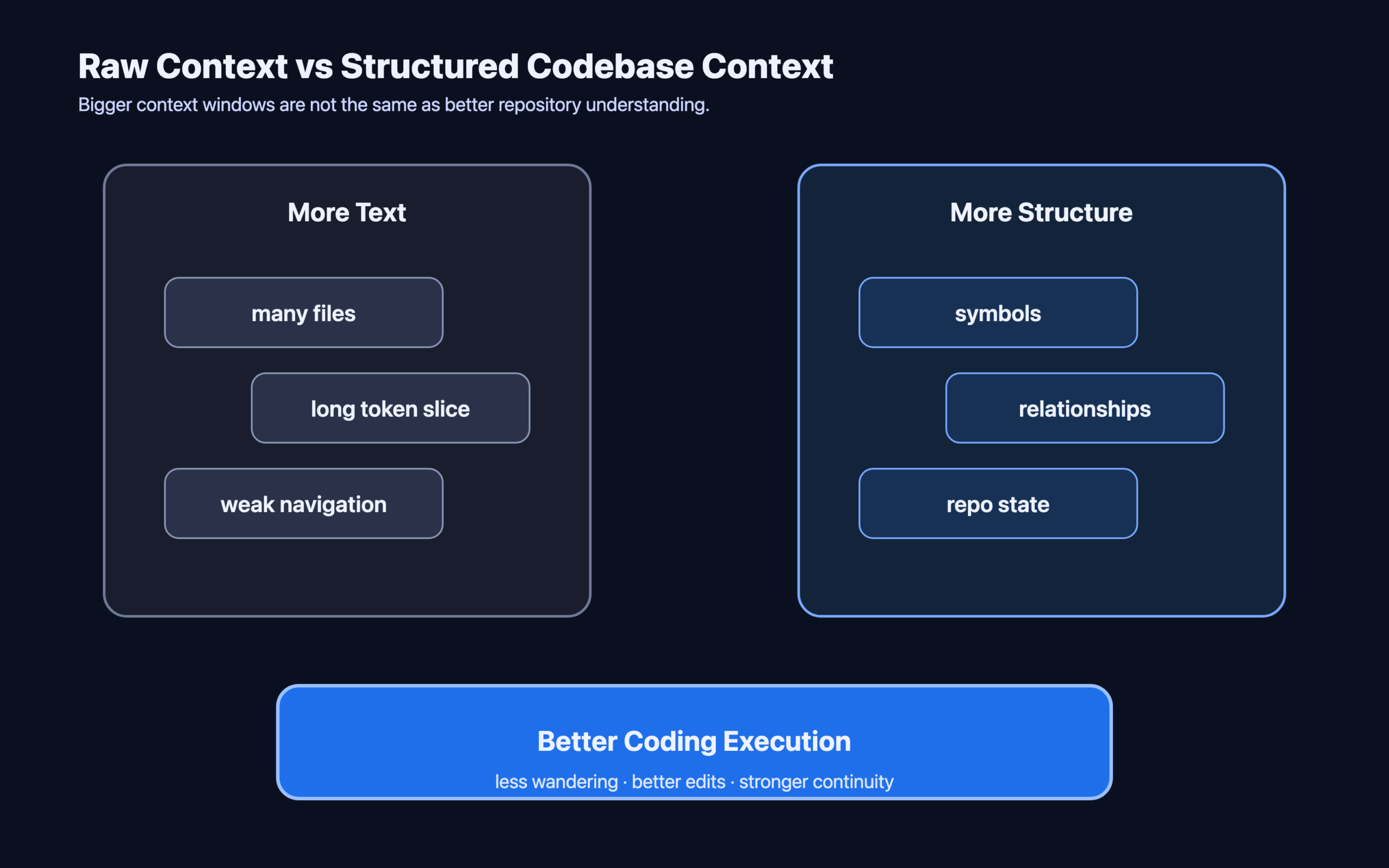
    Bigger context windows are not the same as better context

    One common response is to assume that larger context windows will solve the problem. They help, but they do not solve it.

    More tokens are not the same as better repository understanding. A coding agent can be given more files and still fail to identify which symbols actually matter. It can see more text and still miss the most important relationships. It can load a larger slice of the repository and still struggle to maintain salience as the task evolves.

    In other words, token volume is not a substitute for structure.

    This is the central distinction: a codebase is not just a long string. It is an organized system of references, modules, call paths, dependencies, ownership boundaries, and changing states. Treating it as raw text may be enough for a demo. It is often not enough for real work.

    What structured codebase context actually means

    Structured codebase context means representing a repository in a way that makes its internal relationships usable.

    That usually includes some combination of:

    • symbol-level indexing
    • file and module relationships
    • reference and dependency tracking
    • graph-like navigation between components
    • retrieval tied to structure rather than only keyword similarity
    • explicit links between local context and repository-wide context

    The point is not to build an abstract graph because graphs sound sophisticated. The point is to reduce navigation failure.

    A good coding harness needs a way to answer questions like:

    • where is this symbol defined?
    • what calls it?
    • what else will break if this changes?
    • what files are structurally adjacent to this task?
    • what part of the repository matters right now?

    Those are context questions, but they are also execution questions. They shape whether the agent can make progress without wandering.

    Public systems are already moving in this direction

    The clearest evidence here comes from public implementations.

    GitNexus is a useful example because it approaches repository understanding as a structural problem rather than a pure prompt problem.

    Source URL: https://github.com/abhigyanpatwari/GitNexus

    That matters because it reflects a broader shift: repository context is increasingly being modeled, indexed, and navigated rather than simply pasted into prompts.

    CodeGraphContext pushes in a similar direction. It indexes code into a graph-oriented layer and exposes it through both an MCP server and CLI tools.

    Source URL: https://github.com/CodeGraphContext/CodeGraphContext

    Again, the point is not that one implementation is the winner. The point is that public source code keeps converging on the same idea: coding agents need access to repository structure, not just larger piles of repository text.

    This is also why Part 1 of this series argued that harness engineering is becoming more decisive. Once an agent must work across real files and long task chains, context handling becomes infrastructure.

    Why this is a harness problem, not only a model problem

    It is tempting to describe context handling as a retrieval trick attached to a model. That understates the issue.

    For serious coding workflows, repository context is part of the harness itself. It determines how the system sees the codebase, how it updates its understanding over time, how it narrows attention, and how it keeps multi-step work coherent.

    A stronger model may reason better once the right context is in place. But choosing a stronger model does not by itself decide:

    • how repository structure is represented
    • how relevant context is selected
    • how changing state is tracked
    • how prior work is remembered
    • how partial progress is preserved across steps

    Those are harness design choices.

    And this is where a lot of real-world agent quality will likely be decided. As model capability becomes more accessible, the competitive edge moves toward systems that can make repository context usable, stable, and navigable.

    Bottom line

    The next bottleneck in AI coding is not just model intelligence. It is codebase context structure.

    That is why structured codebase context is moving from a nice-to-have enhancement to a necessary layer in modern coding agents. For real software work, the question is no longer just whether the model can write code. It is whether the surrounding system can help the model understand where that code lives, what it affects, and what should happen next.

    In the next part of this series, I will move from repository understanding to another pressure point in harness design: how long-running agent systems handle state, retries, interruptions, and durable execution.

    Sources

  • Why Harness Engineering Is Becoming the Core Skill in AI Development

    AI development is still mostly described as a model story. A new model ships, benchmark scores improve, context windows expand, tool use gets better, and the discussion moves on to the next release. That story is real, but it no longer explains where a growing share of the engineering difficulty actually lives.

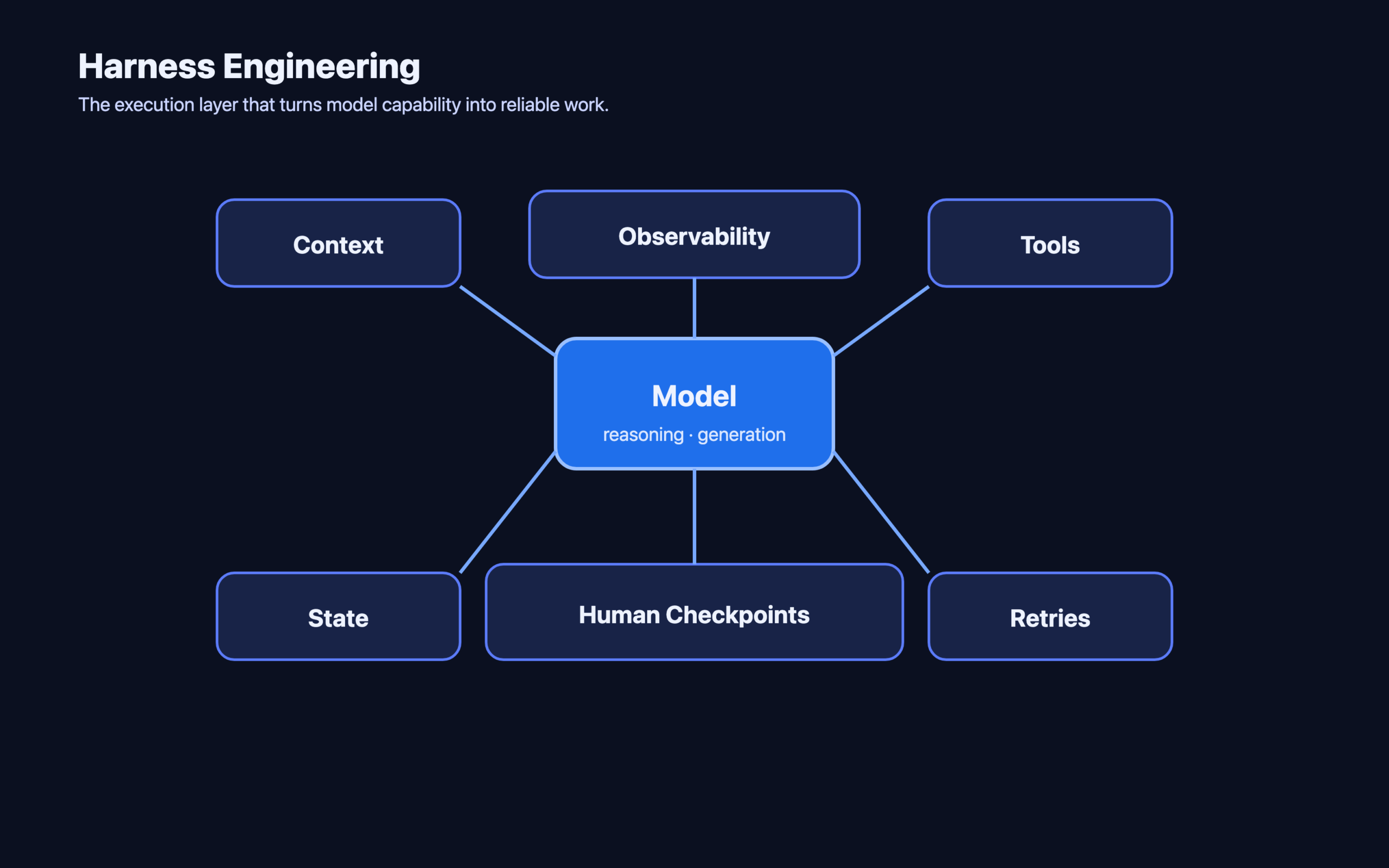
    A better description of the current shift is this: as models become more capable, the surrounding execution structure becomes more decisive. The next layer of competition is not just model intelligence. It is the harness around the model — the architecture that gives it context, tools, state, retries, guardrails, and observability.

    Harness engineering is what turns AI capability into reliable work.

    Why this matters now

    This shift matters now for at least four reasons:

    • stronger base models are becoming easier to access
    • coding agents are making system weaknesses visible in public
    • long-running, tool-using workflows are becoming more common
    • open repositories increasingly expose architecture, runtime structure, and evaluation logic rather than prompts alone

    That changes what builders should pay attention to. It is no longer enough to ask whether a model is smart. The more useful question is whether the surrounding system can make that intelligence dependable.

    Better models did not remove system design problems

    Stronger models solve some problems, but they do not solve the system around the model.

    A more capable model still needs the right context. It still needs boundaries around tool use. It still needs to survive long tasks, partial failures, interrupted execution, and ambiguous states. It still needs a way to explain what happened when things go wrong.

    This distinction between model capability and system reliability is becoming one of the most important distinctions in practical AI engineering.

    The recent paper Building AI Coding Agents for the Terminal: Scaffolding, Harness, Context Engineering, and Lessons Learned makes this explicit. It does not frame the problem as “pick a stronger model and let it run.” It frames the system in terms of shell execution, semantic code analysis, tool design, task management, and explicit completion signals.

    Source URL: https://arxiv.org/html/2603.05344v1

    That framing reflects a broader truth: once an AI system is expected to do real work across files, tools, shell commands, and user checkpoints, the engineering challenge becomes much bigger than prompt quality.

    A strong model without a good harness is often just an expensive demo.

    What harness engineering actually means

    In plain English, harness engineering is the work of building the execution layer around a model so that the model can do useful work in a controlled, repeatable, and debuggable way.

    A good harness usually defines some combination of:

    • context management
    • tool interfaces
    • workflow state
    • retries and recovery logic
    • evaluation hooks
    • traces and logs
    • guardrails and constraints
    • human approval or handoff points

    A model call by itself can produce an impressive answer. A harness determines whether that answer becomes part of a usable system.

    This is why the term matters. It shifts attention from isolated outputs to execution structure. A harness is what decides how a system receives context, how it takes action, how it records progress, how it recovers from failure, and how humans can inspect or intervene when needed.

    Why coding agents exposed this so quickly

    Coding agents are one of the clearest places to see this shift because they expose the limits of model-centric thinking almost immediately.

    A model answering a single question can hide a lot of weaknesses. A model working inside a real codebase cannot. It has to navigate files, symbols, dependencies, shell commands, repository state, and multi-step tasks. It has to distinguish between partial progress and real completion. It has to avoid losing context in the middle of a long task.

    That is why codebase context systems are becoming more important. GitNexus is a useful example because it treats repository understanding as a knowledge graph problem, not just a token problem.

    Source URL: https://github.com/abhigyanpatwari/GitNexus

    CodeGraphContext moves in a similar direction by indexing local code into a graph database and exposing that structure through both an MCP server and a CLI toolkit.

    Source URL: https://github.com/CodeGraphContext/CodeGraphContext

    The point is not that one tool will win. The point is that public implementations are converging on the same lesson: for serious coding workflows, bigger models are helpful, but structured repository context is becoming essential.

    Public source code is revealing the same pattern

    Once you look across public systems, the same architecture keeps reappearing.

    LangGraph presents agent behavior as a graph with explicit state transitions and workflow structure.

    Source URL: https://github.com/langchain-ai/langgraph

    Restate’s AI examples emphasize durable execution, retries, persistence, and resilience.

    Source URL: https://github.com/restatedev/ai-examples

    Dapr Agents emphasizes workflow orchestration, state, telemetry, messaging, and security.

    Source URL: https://github.com/dapr/dapr-agents

    The OpenTelemetry MCP server shows observability moving closer to the agent layer itself, making traces part of the accessible tool environment rather than a separate human-only dashboard.

    Source URL: https://github.com/traceloop/opentelemetry-mcp-server

    Seen together, these are not random implementation details. They point to a shared pattern.

    The pattern looks like this

    • explicit state instead of hidden flow
    • structured context instead of raw token stuffing
    • tool boundaries instead of ad hoc tool calls
    • retries and durability instead of brittle one-shot execution
    • observability instead of opaque behavior
    • human checkpoints instead of assumed autonomy

    One of the clearest public signs of this shift is how reference hubs now organize the field. The awesome-harness-engineering repository, for example, groups the space into foundations, context and memory, guardrails, workflow design, evals, observability, and runtimes.

    Source URL: https://github.com/walkinglabs/awesome-harness-engineering

    That categorization matters because it reflects what builders are actually spending time on.

    The competitive layer is moving outward

    This does not mean model quality stopped mattering. It means model quality is no longer sufficient by itself.

    As strong base models become easier to access, more of the practical difference moves into the surrounding system. Which team can represent context better? Which team can recover from failure gracefully? Which team can inspect a bad run and explain what happened? Which team can make long-running work repeatable instead of fragile?

    Those are harness questions.

    And that is why open source examples matter so much right now. They do not just show that teams are building agents. They show what kinds of system design are starting to become necessary when those agents are expected to do real work.

    What builders should pay attention to now

    If you are building with AI, it is still worth paying attention to models. But that is no longer where the whole game is.

    A better set of questions is:

    • how does the system receive and update context?
    • how does it represent workflow state?
    • how does it call tools and recover from tool failure?
    • how does it trace what happened?
    • how does it let humans inspect, intervene, or approve?
    • how does it turn real-world failures into better evaluations?

    These questions sound less glamorous than model launch headlines. But they are increasingly what separate an impressive demo from a dependable system.

    Bottom line

    The main shift in AI engineering is not that models stopped improving. It is that better models are making the surrounding architecture impossible to ignore.

    That is why harness engineering is becoming a core skill. It is the discipline of making AI systems usable, reliable, inspectable, and repeatable under real conditions.

    In the next part of this series, I will focus on one of the clearest pressure points behind this shift: why modern coding agents increasingly need structured codebase context rather than just larger models and longer context windows.

    Sources