By now, the pattern should be clear.
Better models matter. But once AI systems are expected to do real work, model quality stops being the whole story. What matters just as much is the harness around the model: the structure that gives the system context, state, tools, recovery, observability, and human control. In practice, this is what determines whether an AI agent architecture is reliable enough for real-world use.
That is where the difference between weak and strong systems starts to appear.
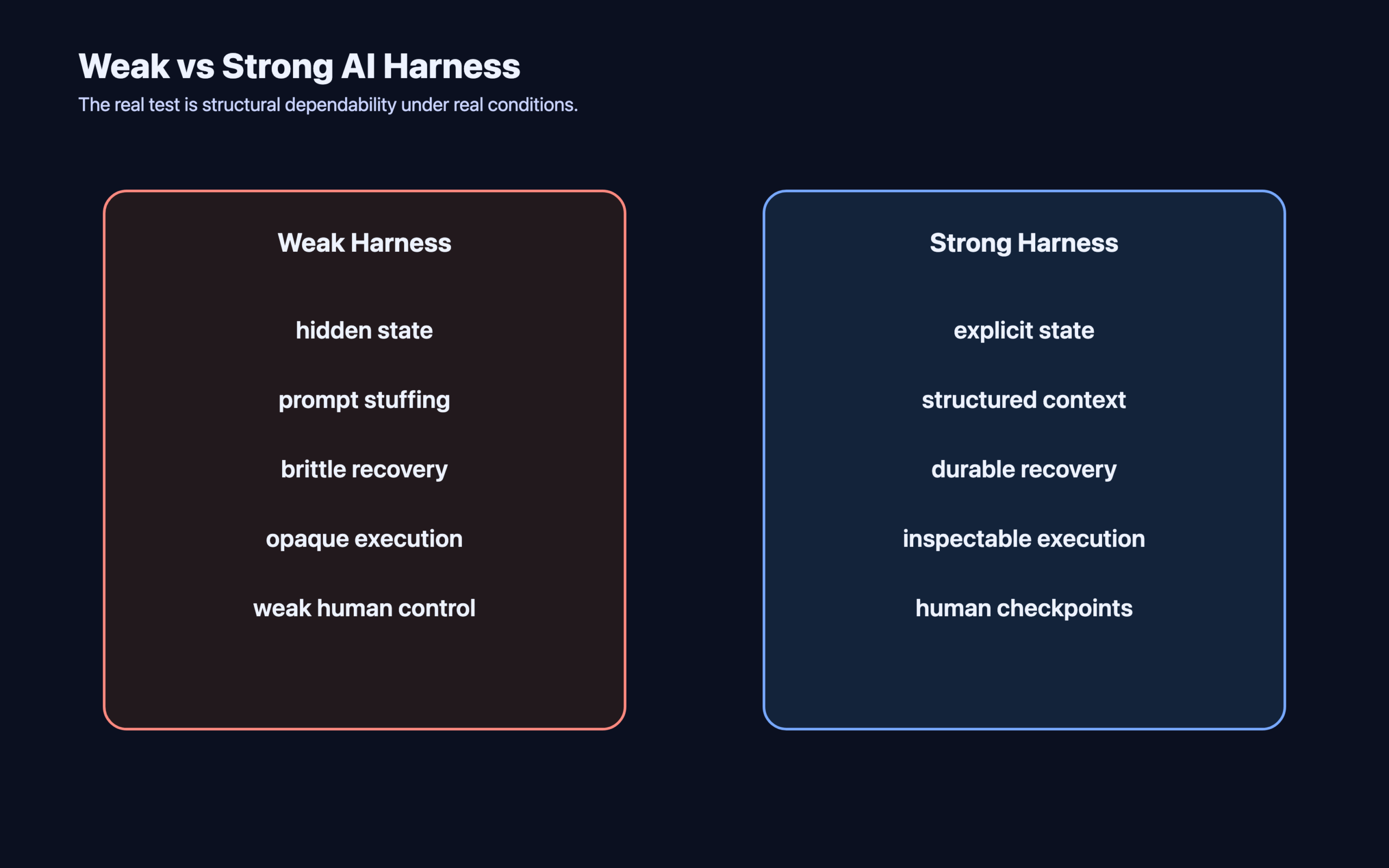
What weak harnesses tend to look like
A weak harness can still look impressive at first.
It may produce fluent answers. It may complete a short task. It may even demo well under controlled conditions. But once the workflow becomes messy, the weaknesses start to surface.
Weak harnesses usually share some combination of the same traits:
- hidden or poorly managed state
- context handled as prompt stuffing rather than structured retrieval or memory
- tool execution that is improvised rather than governed
- little durability when a step fails or the workflow is interrupted
- poor observability when something goes wrong
- weak or missing human checkpoints
The common pattern is not that the model is necessarily weak. The common pattern is that the surrounding system cannot hold together once reality becomes inconvenient.
What strong harnesses tend to look like
A strong harness usually does the opposite.
It makes workflow state explicit. It treats context as a managed system layer rather than a pile of extra text. It wraps tool use inside clearer boundaries. It can retry, resume, checkpoint, and recover. It emits traces that let humans inspect what happened. And it leaves room for approval, intervention, and correction when the workflow matters.
This is what reliable AI agent architecture looks like in practice: explicit state, structured context, tool orchestration, workflow durability, observability, and meaningful human checkpoints.
This does not make the system perfect. It makes it dependable.
That distinction matters. A strong harness is not one that never fails. It is one that fails in ways the system can survive, inspect, and improve.
Why weak harnesses still look good in demos
One reason weak harnesses are easy to overestimate is that demos compress time and complexity.
A short demo hides interrupted workflows, partial failures, stale state, retry logic, messy context changes, and human handoffs. A strong model can cover a lot of structural weakness for a few minutes.
That is why isolated outputs are often misleading. The more serious question is what happens when the task runs longer, tools misbehave, or the surrounding environment changes.
A weak harness often looks strongest right before it is stressed.
Public systems are revealing stronger patterns
Public harness-oriented systems are useful because they show what stronger patterns actually look like in practice.
LangGraph makes explicit state and workflow structure central rather than hidden.
Source URL: https://github.com/langchain-ai/langgraph
Restate’s AI examples emphasize durable execution, retries, and resilience.
Source URL: https://github.com/restatedev/ai-examples
Dapr Agents treats workflows, messaging, state, telemetry, and execution boundaries as part of the architecture itself.
Source URL: https://github.com/dapr/dapr-agents
The OpenTelemetry MCP server shows observability moving closer to the agent layer, making traces more accessible to the system and its operators.
Source URL: https://github.com/traceloop/opentelemetry-mcp-server
The paper Building AI Coding Agents for the Terminal: Scaffolding, Harness, Context Engineering, and Lessons Learned is also useful because it treats scaffolding, context engineering, and task structure as central engineering problems rather than secondary details.
Source URL: https://arxiv.org/html/2603.05344v1
And the awesome-harness-engineering repository is helpful as a category map because it makes visible how many of these same layers keep reappearing across the field.
Source URL: https://github.com/walkinglabs/awesome-harness-engineering
The point is not that these projects are identical. The point is that they keep converging on the same needs.
A practical way to judge a harness
If you want a more useful question than “How good is the model?”, try asking this instead:
- Can the system represent and update state explicitly?
- Can it supply context in a structured, task-relevant way?
- Can it govern tool use rather than improvising it?
- Can it recover when a step fails?
- Can humans inspect what happened through logs, traces, or checkpoints?
- Can the workflow continue without becoming opaque or brittle?
This is not a scorecard. It is a structural lens.
A harness is strong when the system can keep working under pressure without becoming invisible, fragile, or unrecoverable. That is also what makes reliable AI systems possible outside short-lived demos.
The series-level lesson
This is the broader lesson of the whole series.
Part 1 argued that harness engineering is becoming more decisive. Part 2 showed that context structure matters. Part 3 showed that durability changes the engineering problem. Part 4 showed that public systems keep converging on the same architecture layers.
Part 5 turns all of that into a judgment criterion: the real test of an AI system is not whether it can impress in one moment, but whether its surrounding structure can preserve capability when conditions become real.
Bottom line
The difference between a weak AI harness and a strong one is not whether the model can impress you once. It is whether the surrounding system can preserve capability under real conditions.
That means state, context, tool governance, durability, observability, and human control are not side topics. They are the practical criteria that determine whether an AI system is only persuasive or actually dependable.
That is the larger lesson of this whole series. As models improve, more of the real engineering advantage moves into the harness.
Leave a Reply