
A celebrity-backed open-source project can get attention on its own. A celebrity-backed AI memory project with a “100%” benchmark claim gets something more volatile: curiosity, hype, and immediate distrust.
That is what happened with MemPalace.
The project arrived with an irresistible launch story. Milla Jovovich, best known to most people as the face of Resident Evil, was suddenly attached to an open-source AI memory system. The repository took off. The site pushed phrases like “highest-scoring,” “free,” and “local-first.” And the pitch landed in a market already primed for it, because AI power users have been living with the same frustration for months: sessions end, context disappears, and reasoning has to be rebuilt from scratch.
That is why MemPalace matters. Not because a celebrity touched an open-source repository, but because it puts a serious question back on the table: what should an AI memory system actually remember?
The Real Problem MemPalace Is Pointing At
Most people who use AI heavily do not just lose answers. They lose the path that led to the answer.
They lose the earlier debate, the discarded alternative, the half-finished idea, the reason a decision changed, the context that made a tradeoff make sense in the first place. That is the kind of loss that makes many AI systems feel smart in the moment and forgetful across time.
Most memory products try to solve that by compressing conversations into extracted facts, summaries, traits, or user preferences. In many situations, that works. But it also creates a deeper risk: once the system decides what matters, the reasoning context is already gone.
MemPalace takes the opposite philosophical position. Its core idea is simple: do not let the model decide what is worth remembering too early. Store the original material, then make it searchable later.
That is not just a feature choice. It is a theory of memory.
What MemPalace Actually Is

At a practical level, MemPalace presents itself as a local-first AI memory system built around verbatim storage and later retrieval. Public materials describe a structure made of wings, rooms, halls, closets, and drawers—a memory-palace metaphor used to organize the system’s retained context.
Under that framing, the most important concept is not the metaphor itself. It is the insistence that the original material should remain available.
That matters because many memory systems are strongest when the goal is extracting stable facts. MemPalace is more ambitious in a different way. It is trying to preserve the context that sits behind those facts.
That makes the project genuinely interesting.
Why the Idea Is Stronger Than the Launch Story
The celebrity angle got the clicks, but the design philosophy is what gives the project weight.
The real challenge MemPalace poses to the rest of the market is this: if AI systems are allowed to decide what to forget, are they discarding exactly the material advanced users care about most?
That question hits a real nerve. Many people using AI for research, writing, strategy, product work, or technical reasoning do not just want a summary. They want recoverable context. They want to know what was said, why it mattered, what alternatives were rejected, and where the uncertainty lived.
In that sense, MemPalace is not just shipping a tool. It is arguing for a different standard.
Where the Skepticism Becomes Necessary
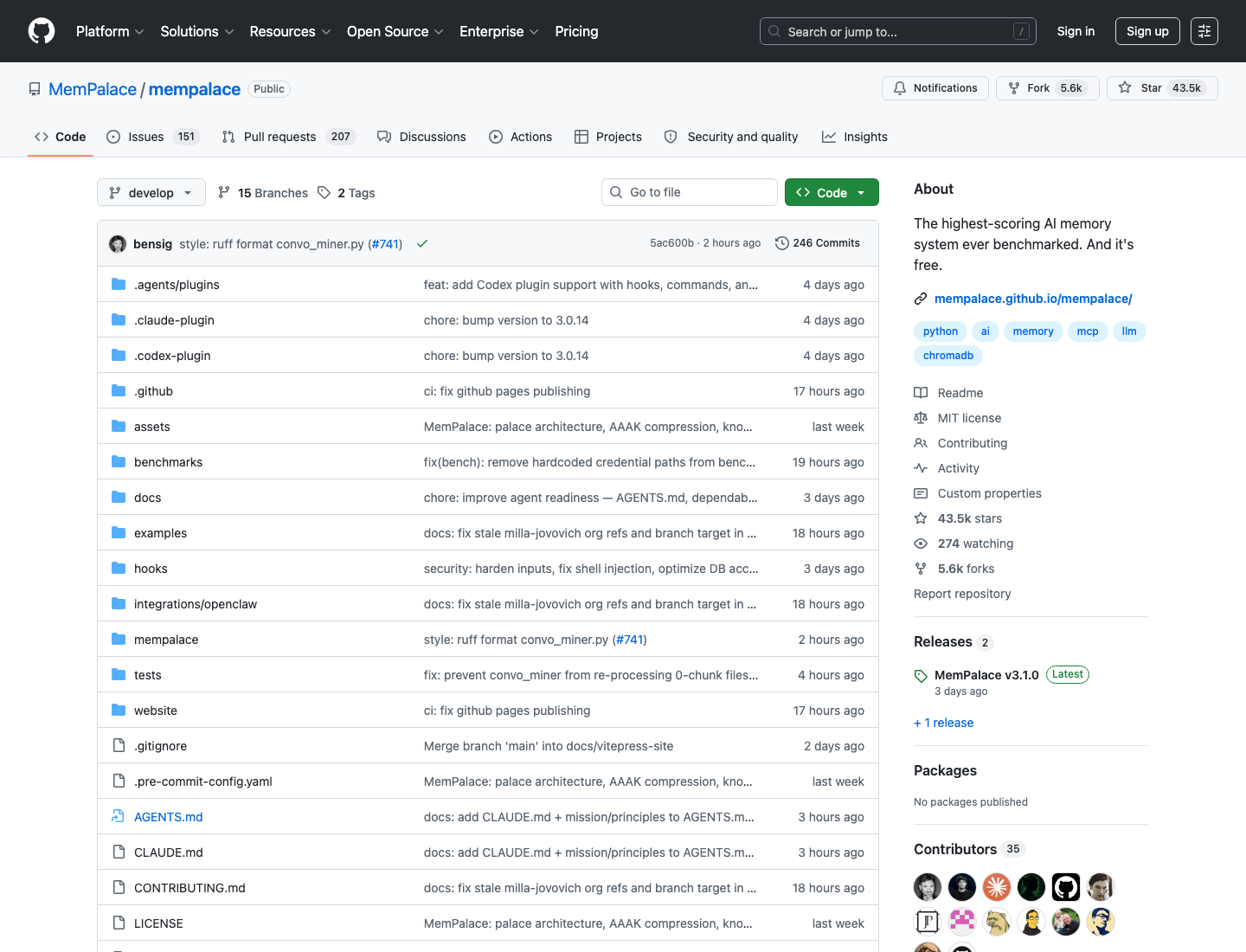
The project becomes harder to trust once you move from the philosophy to the launch marketing.
This is the part that should not be blurred.
The MemPalace README now contains a visible correction note that acknowledges multiple launch-era overstatements or misleading framings. That already tells you something important: the criticism was not merely external noise. Some of it was serious enough that the project had to revise its own presentation.
- the AAAK token example was inaccurate,
- the “30x lossless compression” framing was overstated,
- the “+34% palace boost” framing overstated what was effectively metadata filtering,
- contradiction detection was described more strongly than the implementation justified,
- and the public benchmark story around the 100% reranked result was not fully transparent.
This is why MemPalace cannot be read honestly as either pure breakthrough or pure fraud. The more accurate reading is harder to summarize: there is a real idea here, but the launch framing pushed harder than the evidence justified.
The Benchmark Problem, Broken Into Three Parts
1. The headline problem
“100% on LongMemEval” is a powerful sentence. But it flattens too much. Raw mode, hybrid mode, reranking, API dependency, and evaluation setup can all disappear behind a single number.
That does not make the number fake by definition. It does make it incomplete in a way that matters.
2. The methodology problem
A second layer of criticism focuses on how the result was achieved or communicated. External critiques have pointed to question-specific tuning, retrieval settings, and evaluation framing that may make the headline result look broader or cleaner than it really is.
This is not just academic nitpicking. It goes directly to whether readers should treat the launch claim as a robust result or as a best-case marketing number.
3. The attribution problem
Even when retrieval performance is genuinely impressive, it does not follow that every architectural layer deserves equal credit. Raw retrieval quality, metadata filtering, optional compression, and the palace structure itself should not be blended into one magical story about why the system works.
In other words: the benchmark may still reflect something real, but the story told about that benchmark has to be read with caution.
MemPalace, Mem0, and Zep Are Solving Different Problems
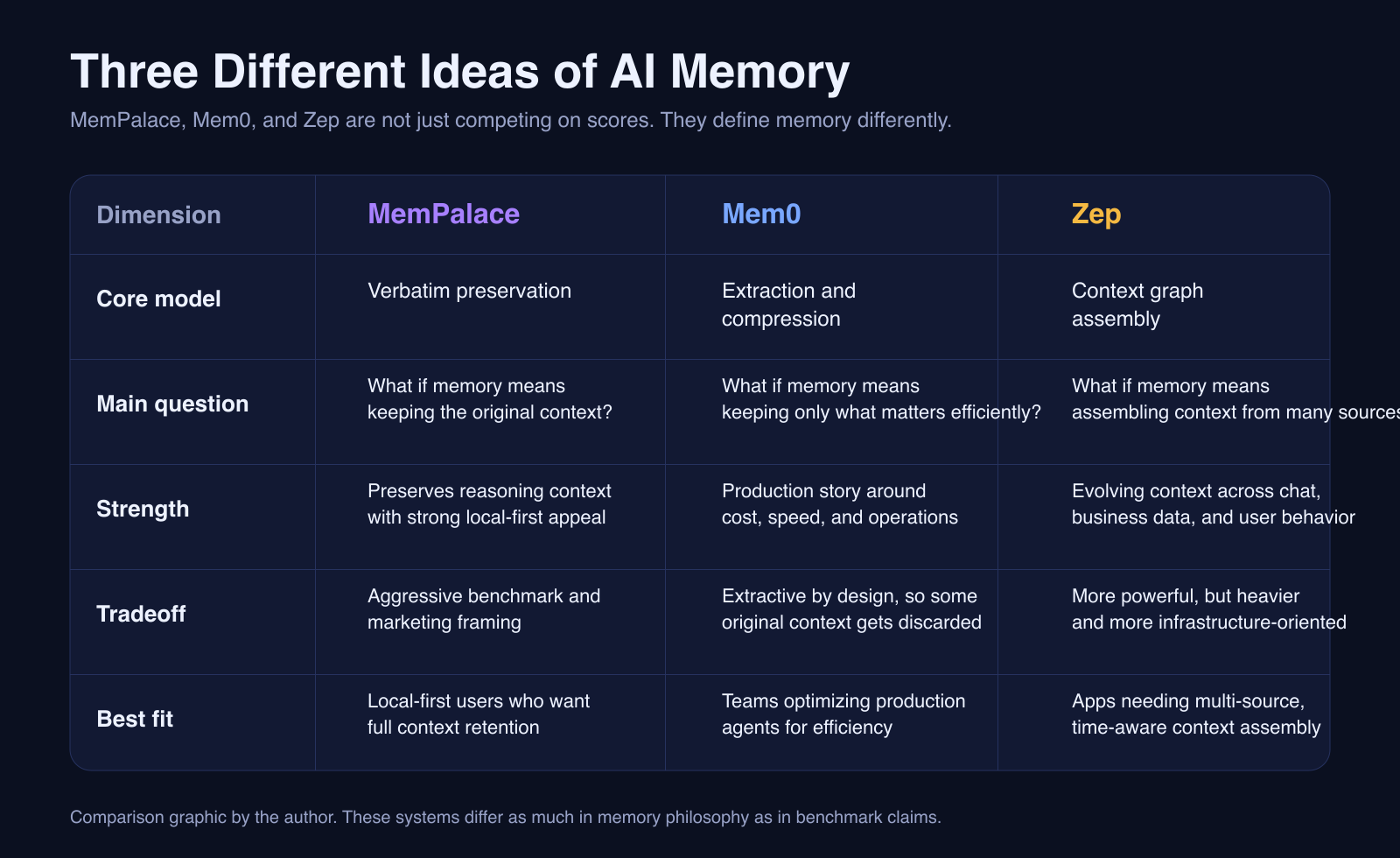
The easiest way to make sense of MemPalace is to stop treating it as a simple benchmark rival and compare it to other systems by memory philosophy.
MemPalace is fundamentally a verbatim-preservation system. It is local-first, open-source, and biased toward keeping the original context available.
Mem0, by contrast, feels much closer to an extraction-and-compression memory layer for production AI apps. Its messaging leans toward cost savings, latency improvements, observability, and enterprise readiness. It is trying to preserve what matters efficiently, not preserve everything.
Zep pushes in yet another direction. It frames itself as context engineering: temporal knowledge graphs, evolving facts, user behavior, business data, and assembled context for real-time agents. That makes it more infrastructure-heavy, but also potentially more powerful in larger application environments.
- MemPalace asks: what if memory means preserving original context?
- Mem0 asks: what if memory means extracting what matters efficiently?
- Zep asks: what if memory means assembling the right context from multiple changing sources?
This is not just a ranking problem. It is a definition problem.
My View
MemPalace does not strike me as a fake project. It strikes me as a real and genuinely interesting local AI memory system with a strong point of view.
But it also strikes me as a project that damaged its own credibility by trying to win too quickly with launch messaging that was more aggressive than it should have been.
That matters because good ideas often become less legible when marketing gets ahead of the evidence. The tragedy is not that MemPalace has no substance. The tragedy is that it may have had enough substance to be interesting without overplaying the benchmark story.
So my conclusion is simple.
MemPalace is not compelling because a celebrity helped launch it. It is compelling because it reopens a serious question about AI memory: should memory optimize for compressed summaries, or for preserving the original context people may actually need later?
That is the part worth taking seriously.
The benchmark headline is the part worth doubting.
And the most honest way to read the project is to hold both of those truths at once.
Leave a Reply