One of the easiest ways to misunderstand the current agent landscape is to focus too much on product names.
One system uses graphs. Another emphasizes durable workflows. Another focuses on telemetry. Another packages itself around MCP servers or infrastructure APIs. On the surface, these systems can look very different. But if you compare them at the architecture level, something more important appears.
The same patterns keep coming back.
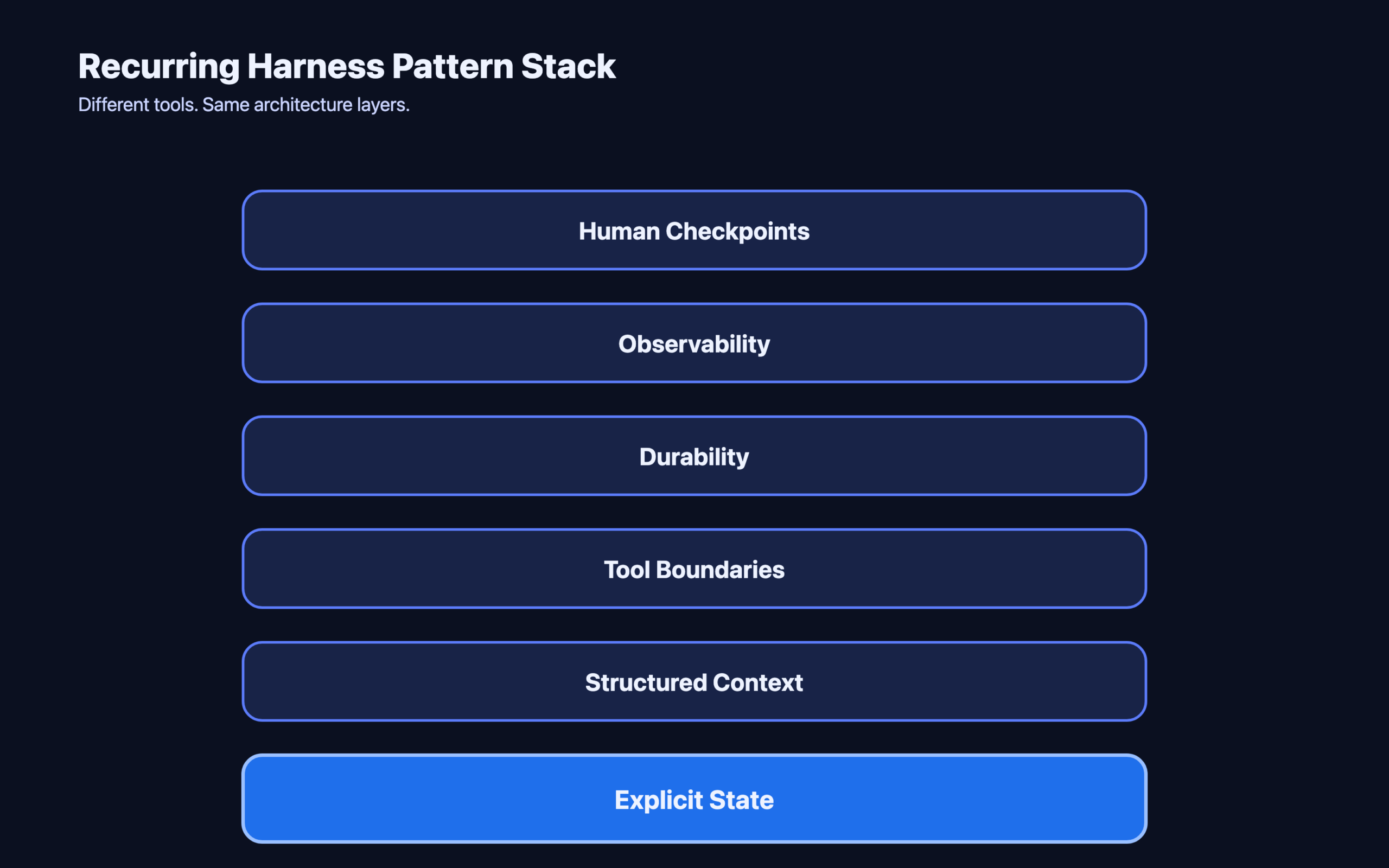
That is the deeper signal. The field is not only producing more agent frameworks. It is converging on a shared set of harness layers.
Why pattern-level comparison matters
Tool names change quickly. Architecture lessons usually last longer.
If you compare systems only by branding, language, or surface features, you miss the more durable story. The useful question is not which project has the best demo page. The useful question is which design choices keep reappearing when builders try to make agents usable in the real world.
That is why pattern-level comparison matters. It helps separate what is fashionable from what is becoming necessary.
The repository awesome-harness-engineering is useful here because it already organizes the field around recurring categories rather than around a single winning tool.
Source URL: https://github.com/walkinglabs/awesome-harness-engineering
That kind of category map is a signal in itself. It suggests that builders are spending time on shared system problems, not just isolated implementations.
Pattern 1: explicit state
One of the clearest recurring patterns is explicit state.
A weak harness hides workflow state inside model messages, scattered prompts, or untracked local assumptions. A stronger harness makes state visible and structured.
LangGraph is an obvious example because it treats agent execution as a stateful graph rather than a vague sequence of calls.
Source URL: https://github.com/langchain-ai/langgraph
The point is not that every system must literally be graph-shaped. The point is that real workflows need state that can be inspected, updated, and reasoned about deliberately.
Pattern 2: structured context
The second recurring pattern is structured context.
Useful systems keep moving away from the idea that context means pasting more text into a prompt. Instead, they treat context as a managed layer: memory, retrieval, indexing, structure, and task-relevant focus.
This is one reason the harness conversation keeps intersecting with codebase context, memory systems, and retrieval design. The architecture is telling us that context is not just input volume. It is a system responsibility.
Again, the category structure in awesome-harness-engineering is useful evidence because it places context and memory alongside guardrails, evals, observability, and runtimes rather than treating them as side concerns.
Source URL: https://github.com/walkinglabs/awesome-harness-engineering
Pattern 3: tool boundaries and execution interfaces
Another repeated pattern is the way serious systems mediate tool use.
In weak systems, tool execution can feel like an improvised extension of prompting. In stronger systems, tools are wrapped, constrained, typed, mediated, and connected to broader workflow logic.
Dapr Agents is useful here because it frames agent execution in terms of workflows, messaging, state, telemetry, and infrastructure concerns rather than as a single free-floating model call.
Source URL: https://github.com/dapr/dapr-agents
That matters because it shows tool use becoming part of a governed execution interface, not just a trick for making the model look more capable.
Pattern 4: durability and recovery
Once workflows become longer-running, another pattern appears: durability.
Systems that aim at real work keep adding retries, persistence, resumability, and recovery-aware execution. This is not decorative engineering. It is the difference between something that works once and something that can survive production conditions.
Restate’s AI examples are useful evidence because they make durability, retries, and resilience part of the public story rather than hiding them in infrastructure layers nobody talks about.
Source URL: https://github.com/restatedev/ai-examples
This pattern also reinforces a larger point from Part 3 of this series: workflow time changes the architecture.
Pattern 5: observability
A fifth recurring pattern is observability.
As agents become more capable and workflows become more layered, it becomes harder to trust opaque execution. Builders need traces, telemetry, inspection points, and a way to connect bad outcomes back to specific steps.
The OpenTelemetry MCP server is a useful sign of this direction because it suggests observability moving closer to the agent layer itself.
Source URL: https://github.com/traceloop/opentelemetry-mcp-server
LangSmith’s MCP server points in a similar direction, connecting tooling and inspection more directly into the agent ecosystem.
Source URL: https://github.com/langchain-ai/langsmith-mcp-server
This matters because observability is not just a monitoring concern. It is part of how a harness learns, debugs, and improves.
Pattern 6: human checkpoints
One more recurring pattern is human-aware control.
Serious harnesses do not assume perfect autonomy. They assume that humans may need to approve, redirect, inspect, or override system behavior.
This pattern may be less flashy than model demos, but it shows up repeatedly because it reflects real operational conditions. The more consequential the workflow becomes, the more important it is to keep meaningful checkpoints in the loop.
That is also why many harness discussions naturally connect approvals, guardrails, auditability, and intervention. These are not signs that the system is weak. They are signs that the system is being designed for reality.
The deeper takeaway
What matters here is not that every public system looks the same. They do not.
What matters is that the same architectural needs keep resurfacing from multiple directions. Different teams, tools, and ecosystems keep rediscovering the same requirements once they move beyond toy workflows.
That is why this convergence matters. It suggests the field is not just experimenting randomly. It is slowly identifying the layers that serious agent systems require.
Bottom line
Public harness-oriented systems may look different on the surface, but they keep converging on the same architecture layers.
Those layers include:
- explicit state
- structured context
- tool boundaries
- durability and recovery
- observability
- human checkpoints
This is the real signal in the current landscape. The field is not just experimenting with many random agent ideas. It is gradually discovering the same system requirements from multiple directions.
In the final part of this series, I will turn that convergence into a sharper question: if these layers keep reappearing, what actually separates a weak harness from a strong one?
Leave a Reply